
Developing AI-powered ultrasound simulation technologies
Industry
Healthcare
Use Case
Ultrasound Analysis
Company size
51-200 employees
Headquarters
Cardiff, UK
About
Intelligent Ultrasound’s vision is to make clinical diagnostic ultrasound easier to learn and simpler to use.
Founded in 2004 in Cardiff, UK, and Georgia, USA, Intelligent Ultrasound is unlocking ultrasound for everyone by training clinicians in the classroom, and then supporting and guiding them in the clinic, with real-time AI based image analysis software.
To date, the company has installed over 1,350 simulator systems in more than 650 world-leading medical institutions around the globe.

The challenge
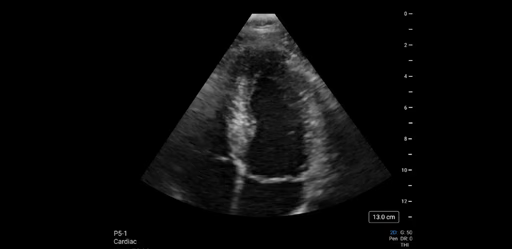
From a computer vision perspective, ultrasound images are extremely complex to annotate and challenging to use in a model-training pipeline. The structures that doctors aim to identify do not have easily distinguishable borders, which makes the annotation process tedious and error-prone.
The solution
Intelligent Ultrasound uses GTCX to annotate sequential and non-sequential ultrasound data 30% faster (with higher accuracy) and doubling their release velocity to build AI-powered image analysis software for medical institutions worldwide.
The results
Since adopting GTCX, Intelligent Ultrasound have sped up their annotation and review process and improved their workflow collaboration.
The same team is now able to process twice as many images as previously, ship products faster to market, as well as train sonographers and radiographers more efficiently.
“Thanks to GTCX, the image annotation is 30% faster, but, realistically, considering the whole process—transferring files and QA—we more than doubled the number of images we can do in the same span of time.”
Testimonial
"One of the benefits of switching to GTCX - especially when annotating non-sequential images - is that every time we look at the new image, we can create another copy of the same mask without having to manipulate it."
Training data needs
Intelligent Ultrasound is currently working on two main projects:
ScanNav Anatomy PNB (Peripheral Nerve Block)—the real-time AI assistant for training and clinical practice of ultrasound-guided regional anesthesia.
Obstetric images to support their m license and co-development agreement with GE Healthcare that enables the integration of Intelligent Ultrasound’s real-time AI image analysis software into GE Healthcare’s Voluson women’s health ultrasound portfolio
The team annotates data according to the medical guidelines provided by sonographers and clinicians—they look for and highlight relevant structures in ultrasound images, depending on the project at hand.
Intelligent Ultrasound labels on average 30,000 sequential and 5,000–8,000 non-sequential images per week.
Why GTCX?
Intelligent Ultrasound found GTCX while looking for an alternative to the tools they were already using—an image manipulation software and their own internal labeling solution.
The team wanted to speed up their labeling and enhance the efficiency of their workflows—eliminate time-consuming file transfers, improve the annotation review process, and automate the creation of multiple instances of the same mask across images.
GTCX’s intuitive interface and the brush and pen tools meant that instead of manually clicking different points and moving them over for each image, the team could just produce new annotations almost automatically.
Additionally, GTCX's ability to create custom workflows enabled Intelligent Ultrasound's team to stay aligned on quality control and avoid poor data bleeding into the model.